
Should You Still Bother With Pinterest Group Boards for Marketing?
Pinterest group boards marketing used to be the fastest shortcut on the platform. Join twenty boards, get in front of a hundred thousand followers you did not have to earn, watch the traffic arrive. Bloggers built entire strategies around it from 2016 to 2018.
That version is over. Group boards themselves are not, though. Pinterest still builds and supports them, still ships permission settings for them, and still lets anyone request to join one. What changed is the reason marketers wanted them in the first place.
My quick answer: joining group boards is no longer a growth channel worth chasing, but a few specific uses still earn their keep. Below is how to tell which situation you are in.
What Pinterest group boards are
A group board is a normal board with more than one person allowed to save Pins to it. You turn any board you own into one by inviting collaborators, either by name, username, email, or a shareable link.
Pinterest’s own documentation frames them as a way to share ideas and plans, and gives the board owner four permission levels to control what collaborators can do:
- Do (almost) everything: add, move, and delete Pins and sections, plus comment and react
- Save and comment: save and organise Pins, comment and react
- Invite other people: collaborators can bring in others
- Board requests: strangers can request to join
Read that list back. Every setting is about managing a shared workspace. None of it is about distribution. Pinterest built collaborative boards for wedding planning and team moodboards, and marketers repurposed them. The feature never changed its purpose. The marketing use case was always a workaround.
Why group boards stopped working as a growth channel
Three things happened, and only two of them are documented.
- Following stopped meaning what it used to mean
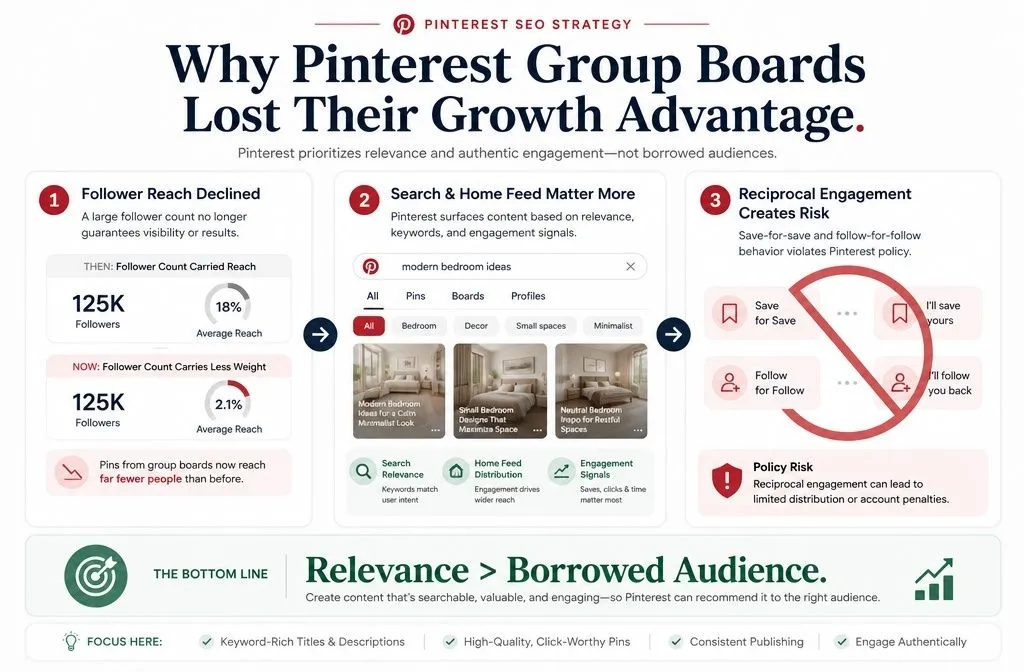
The original mechanic was simple. Pins saved to a group board reached the followers of everyone attached to the board, so a board with 200,000 followers acted like a borrowed audience. Practitioners and tools including Tailwind report that Pinterest later restricted group board Pin distribution, and that following an account does not automatically follow the group boards that account merely contributes to.
Worth being precise here: Pinterest has never published an announcement confirming a group board demotion, and you will not find one in the Help Center. Treat the claim as strong practitioner consensus rather than platform doctrine. What is not in dispute is the outcome. Nobody in 2026 reports group boards behaving like the distribution multiplier they were in 2017.
- Follower reach matters far less than it did
Even if group board distribution were untouched, Pinterest now surfaces the overwhelming majority of Pins through search and the home feed, both driven by keyword relevance and engagement signals rather than who follows whom. A borrowed follower count is a weak lever when followers are not the mechanism.
- Reciprocal pinning schemes now brush against Pinterest’s own rules
Most open group boards run on quid pro quo. Pin one, repin three. Follow all contributors. Save mine, and I save yours.
Pinterest’s Community Guidelines prohibit coordinating with other people to manipulate the platform, and prohibit tactics that attempt to improperly influence distribution, clicks, or other metrics. The Commercial and Branded Content Guidelines go further and specifically name asking other users to save your affiliate Pins in a quid pro quo as prohibited behaviour.
Those rules were not written about group boards. They cover the mechanics that most group board etiquette lists still recommend. If your Pinterest group boards marketing plan depends on a reciprocity agreement, you are running a strategy the platform’s published policy already describes as manipulation. That is not a risk worth taking for a channel that no longer delivers.
Where Pinterest group boards still earn their keep
Three cases survive the above.
Boards you own. When you follow someone, you follow the boards they own, including group boards they own. Owning the board keeps that follow relationship intact and gives you full moderation control. A board you own with three carefully chosen contributors is a real asset. A board you joined with 500 strangers is not!
Genuine collaboration with a small, matched partner. Two or three creators in the same niche, all pinning quality content on one tight topic, is exactly what the feature was built for. The value is not borrowed reach; it is a legitimately good board that accumulates saves because the content is consistently relevant.
Client and team workflow. If you manage Pinterest for clients, a private collaborative board is the cleanest way to review Pin concepts before anything goes live. No algorithm involvement, pure utility.
Notice what all three have in common. The board earns distribution on relevance, not on a follower shortcut.
Are Pinterest group boards worth it for your account? Four questions
Run these before you request to join anything.
- Is every Pin on the board on one clear topic? Mixed-topic boards give Pinterest confusing signals about what your Pin is about. That works against you, not for you.
- Are the recent Pins good? Scroll the last 30 saves. If it reads as a link dump, the board is diluting the relevance of anything you add.
- Does joining require reciprocal engagement? If the rules ask you to save other contributors’ Pins in exchange for the privilege, walk away on policy grounds.
- Could you build the equivalent board yourself in an afternoon? Usually yes. And you would own it.
If a board fails any of the four, the honest answer to “are Pinterest group boards worth it” for that board is no.
Audit the group boards you already belong to
Do not delete anything on principle. Measure first. This takes about twenty minutes.
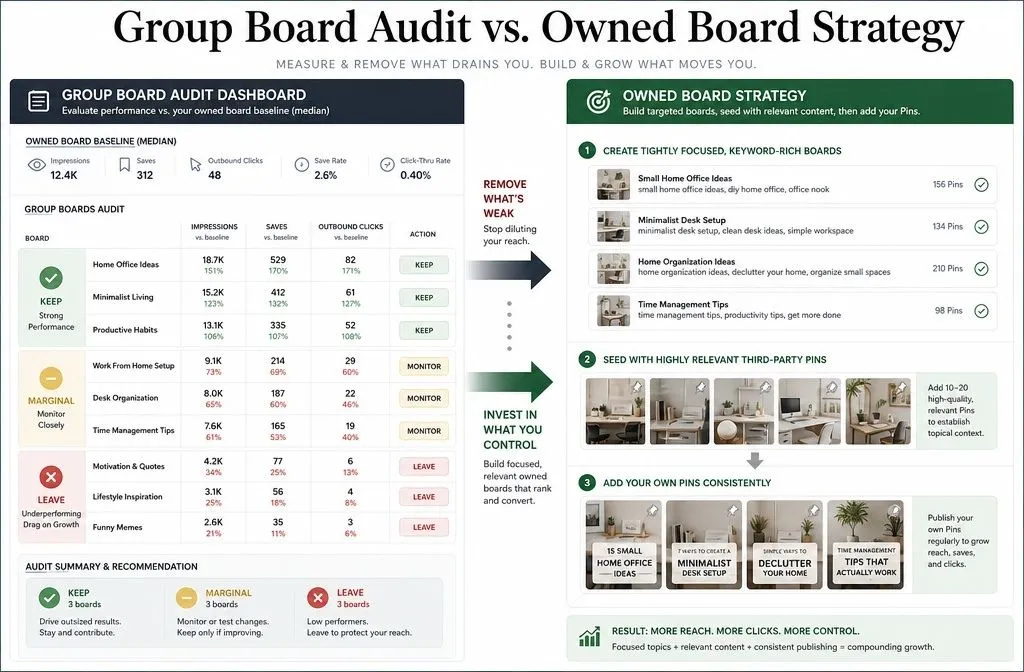
- Open Pinterest Analytics and set the date range to the last 90 days.
- Filter or segment by board. Pull three numbers per board: impressions, saves, and outbound clicks.
- Cross-check against your website analytics for Pinterest referral sessions over the same window.
- Compare each group board against your median owned board. Not against zero, against your own baseline.
- Sort into three buckets. Performing at or above your median, marginal, or effectively dead.
Anything in the dead bucket after 90 days of your Pins sitting there is not a traffic source; it is a relevance liability. Leave the board and move any Pin that did perform to a board you own.
Anything performing at or above your median is worth keeping, and worth understanding. Look at why. Usually it is a narrow topic and an owner who moderates.
If reading your Pinterest Analytics is where you get stuck, that is the part I handle for clients. A Pinterest audit usually turns up two or three boards quietly dragging on an account, along with the keyword gaps that matter more than any group board ever did.
What to do instead
The effort you would spend hunting for group boards to join is better spent on boards you control.
Build one tightly named board per topic cluster you publish on, write a description that uses the synonyms and related terms people actually search, then seed each new board with a batch of strong, relevant third-party Pins before you add your own. Seeding does the job people hoped group boards would do. It tells Pinterest what the board is about, so your Pins get matched to the right audience faster, and you keep full control of quality.
The compounding comes from volume and relevance over time, not from a shortcut. Ten well-targeted Pins a day to well-named boards will outperform any group board strategy you can assemble in 2026, and it will not put your account at risk.
If you still want to join, do it this way
Find candidates by looking at accounts in your niche that already rank for your keywords, and check which group boards appear on their profiles. Board descriptions usually state how to request access, and Pinterest also supports a Join button when the owner enables board requests.
Then join a maximum of three. Pin at a normal cadence, not a burst. Do not agree to reciprocal saving. Re-audit at 90 days and cut what did not perform.
That is a reasonable amount of effort for a channel with a low ceiling. Anything more is time taken from work that compounds.