Most people post their Christmas pins on December 1st. Then they wonder why nothing happens.
Here’s the uncomfortable truth about seasonal Pinterest marketing: by the time a holiday arrives, the traffic is already gone. Pinterest isn’t Instagram. Nobody opens the app on December 20th looking for cookie recipes to bake that night. They looked in late October, decided what to make, and saved it to a board. The party happened weeks before the party.
So the whole game is timing. And the number that keeps you on time is 45 days.
Why Pinterest runs on a delay
Pinterest is a search engine that happens to have a follow button. People come here to plan, and planning happens early. Pinterest’s own data shows holiday activity spiking as early as September, and their research says Pinterest users are more than twice as likely as non-users to invest real time preparing for seasonal moments.
That changes the math for anyone doing seasonal Pinterest marketing. A pin about cozy fall entryway styling posted in early August can still be pulling traffic in October. Try that with a TikTok posted the same week. It’s gone before the season even starts.
There’s a second reason for the delay, and it’s the one most guides skip. When you publish a fresh pin, Pinterest needs time to crawl it, read your landing page, figure out what it’s about, and decide who to show it to. That indexing and testing period is not instant. Your pin needs a running start to build engagement signals before search volume peaks, not after.
Put those two things together and you get a simple rule. Be early, or be invisible.
The 45-day rule, and the reasoning behind it
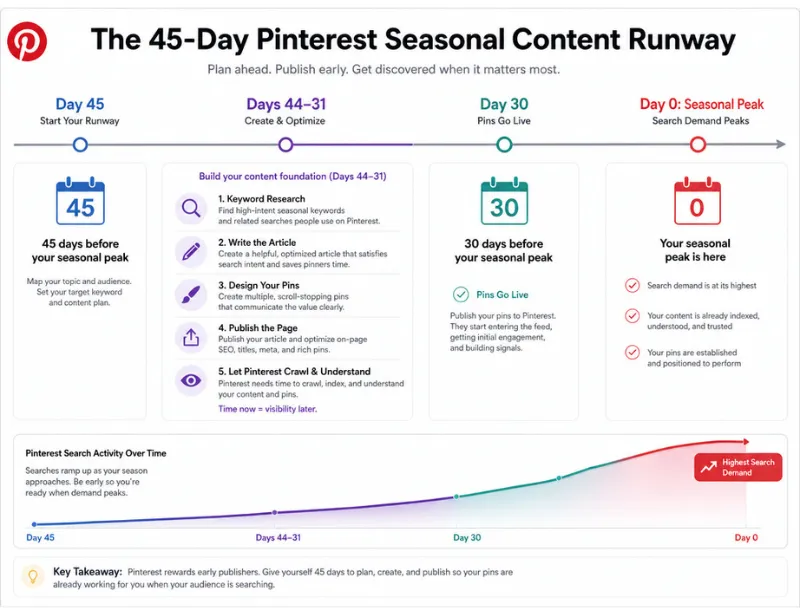
Pin your seasonal content at least 30 days before the season or holiday. That part is standard advice. But 30 days is when the pins need to be live, not when your work starts.
Add a 15-day runway on the front end for the actual work: writing the post, designing the pins, letting Pinterest crawl your landing page and start ranking it. That’s where 45 days comes from. Thirty days live, plus fifteen days of preparation and crawl lag before that.
- Days 45 to 31: research the keyword, write the blog post, design the pins, publish the page so Pinterest can crawl it
- Day 30: pins go live and start collecting early impressions
- Day 0: the season peaks, and your pins already have distribution
I’ll be straight with you: 45 days is the floor, not the ceiling. For the big ones, Christmas, Thanksgiving, Black Friday, you want more. Pinterest’s business team tells advertisers to go live as early as September for the winter holidays, and agencies running Pinterest at scale often publish 60 to 90 days out. The 45-day rule is the minimum that reliably works for most seasonal content. Treat major holidays as their own case and push earlier.
Plan backward from the peak, not forward from today
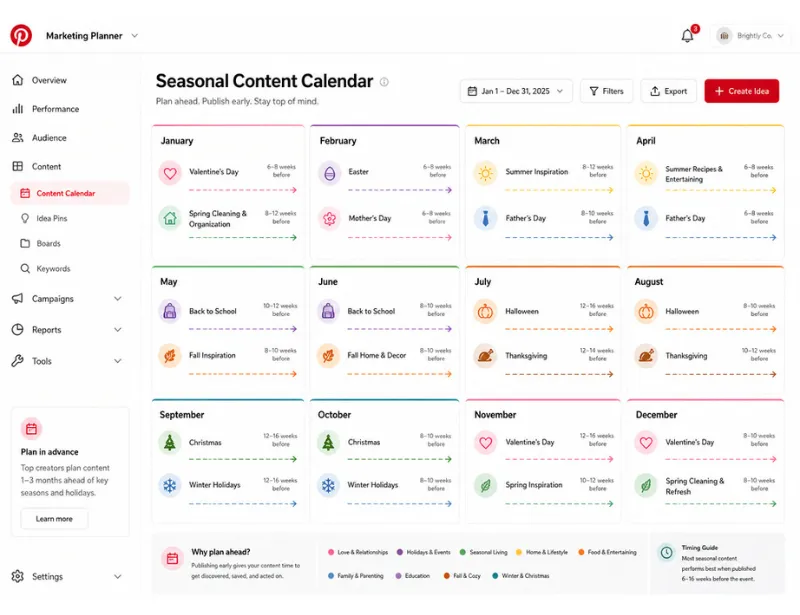
Most brands map their calendar forward. They start from today and ask what’s coming up. On Pinterest that’s backwards.
Start from the peak search date and count back. Pick the event. Find the date searches actually crest, which is usually a week or two before the event itself, not the day of. Then subtract 45 days. That’s your publish date. If it feels absurdly early, you’re doing it right.
An example. Valentine’s Day peaks around early February, so searches climb through January. Count back 45 days and you’re publishing in early-to-mid December. While everyone else is buried in Christmas, you’re quietly seeding the next season. Doing your seasonal keyword research 45 days early is what makes this possible, since you can’t plan content around keywords you haven’t pulled yet.
A month-by-month pinning calendar
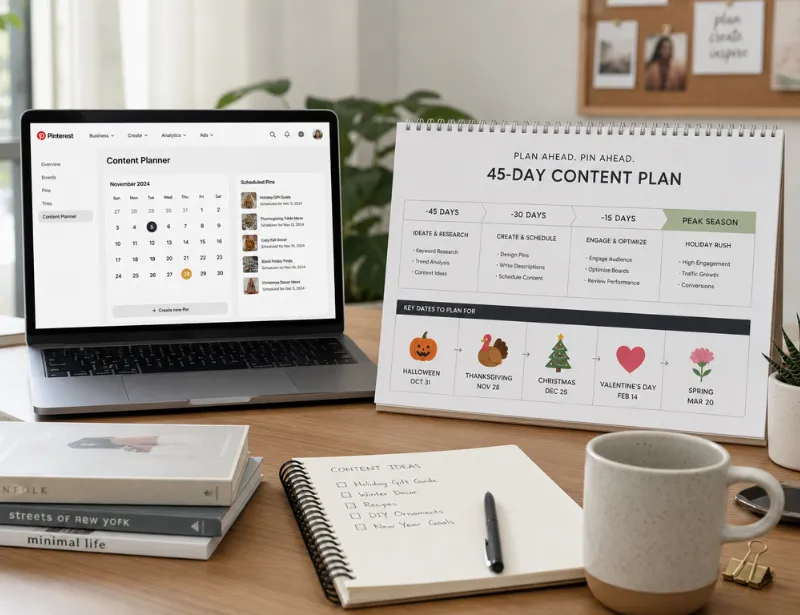
Here’s roughly what you should be pinning each month if you want to ride the seasonal waves instead of chasing them. Notice how early everything sits.
- January: Valentine’s Day, spring cleaning, New Year organization
- February: early spring, Easter, Mother’s Day prep
- March and April: summer, Father’s Day, graduation, wedding season
- May and June: back-to-school, early fall
- July and August: Halloween, Thanksgiving, early Christmas
- September and October: Christmas, winter holidays, New Year
- November and December: Valentine’s Day and next year’s spring
Use the Pinterest Trends tool to pin down exactly when a given topic starts climbing in your niche, since the curve shifts a little by category and by year. Home and gift content tends to build earliest.
Don’t let seasonal content eat your whole calendar
One trap worth naming. Seasonal pushes are exciting, and it’s easy to let a Christmas sprint crowd out everything else. Don’t.
The healthiest approach is a steady base of evergreen pins with seasonal ones layered on top at the right time. Evergreen content pays the bills year-round. Seasonal content is the spike on top. If you drop your evergreen pinning every time a holiday rolls around, your account loses the momentum that makes the seasonal spikes land in the first place. A real Pinterest content calendar keeps that balance honest so you’re not swinging between feast and famine.
What to do when a pin doesn’t take off
Sometimes you’ll do everything right and a seasonal pin still underperforms. Before you blame the timing, check the order of operations.
Look at impressions first. Low impressions usually means the keyword targeting or the pin design is off, not the timing. High impressions with low clicks means the pin got shown but the title or image didn’t earn the tap. And if you published late, inside that 30-day window, give it a season before you judge it. Pinterest may not have finished indexing and testing it before the peak passed. Understanding how the Pinterest algorithm works makes these diagnostics a lot faster, because you’ll know which signal to read first.
The bottom line
Seasonal Pinterest marketing rewards one thing above all: being early. Plan backward from the peak, give yourself the full 45-day runway, and push the big holidays earlier still. Do that consistently and you stop chasing seasons. You start arriving before them.