
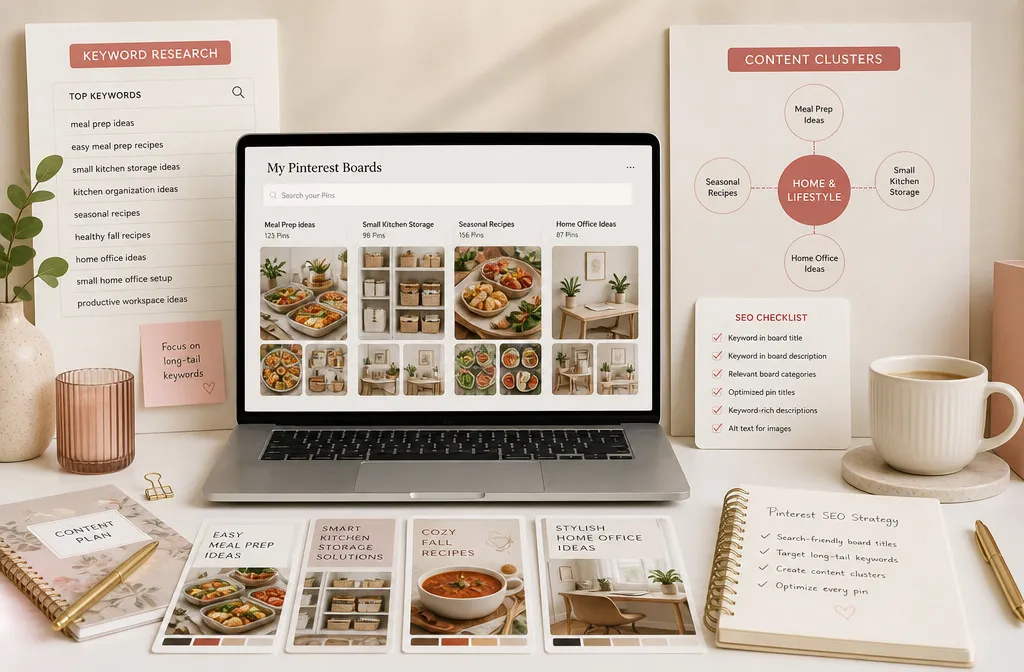
Most lists of Pinterest board ideas hand you a stack of names to copy and move on. That’s a mistake if traffic is the goal, because a board name is one of the clearest signals you can hand Pinterest about who should see your pins.
Good Pinterest board ideas do two jobs at once. They organize your content for the people following you, and they tell Pinterest’s search engine exactly what topics you cover. Pinterest itself has confirmed that boards carry real weight in the system: close to a quarter of Pinterest’s SEO traffic flows through boards, not just individual pins.
This guide skips the generic “try these 20 board names” approach. Instead, it walks through a repeatable framework for generating, structuring, and seeding board ideas so each one earns its place in your account.
Why Board Ideas Are an SEO Decision, Not Just an Organizing Task
Pinterest doesn’t crawl your website the way Google does. It leans on the text you give it: pin titles, pin descriptions, and board names.
A board name gives Pinterest broad context for every pin saved to it. Vague names like “Inspiration” or “My Favorites” tell the algorithm almost nothing, so pins on those boards get shown to a fuzzier, less relevant audience. Specific, keyword-rich names do the opposite. They let Pinterest match your content to searchers with real intent.
That’s why board ideas deserve the same research you’d put into a blog post topic. Every board is a standing keyword target that either helps or hurts every pin placed on it going forward.
Start With Pillar Board Ideas Built Around Your Main Keywords
Before brainstorming, open the Pinterest search bar and type in your niche’s core topic. The autocomplete suggestions that appear are real phrases people search for, and they make a strong starting list for pillar board ideas.
Pillar boards should be broad enough to keep growing for years but specific enough that every pin belongs there. “Recipes” is too broad. “Dinner Recipes” or “Slow Cooker Recipes” gives Pinterest enough to work with while still leaving room to add pins indefinitely.
Aim for 5 to 10 pillar board ideas to start. These become the backbone of your account, and every other board idea in this guide builds outward from them.
Generate Long-Tail Board Ideas With Qualifier Keywords
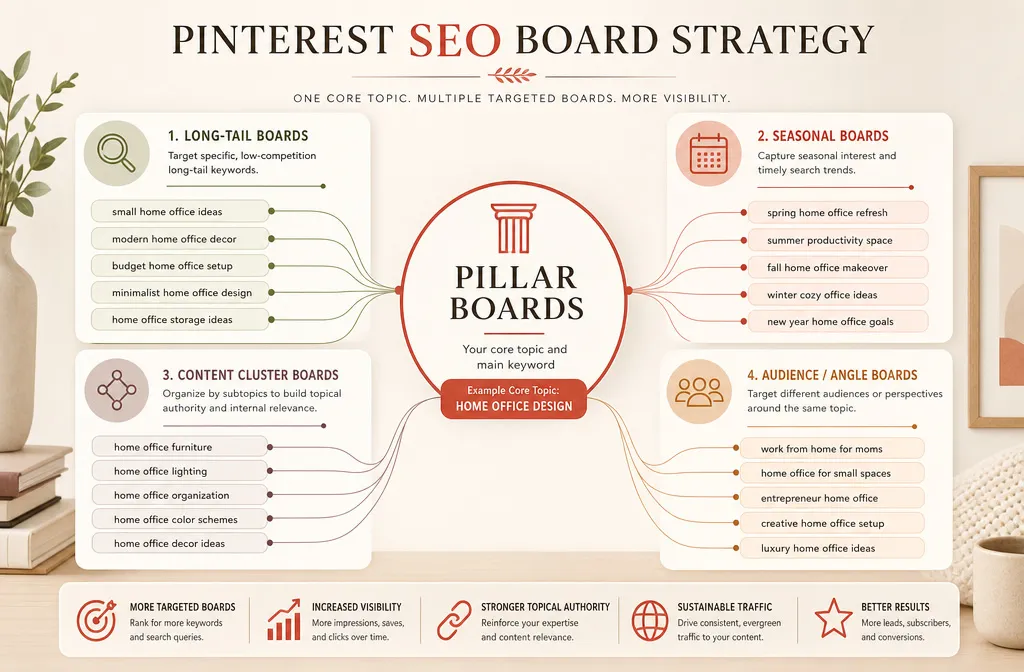
Once the pillar boards exist, qualifier words turn one broad keyword into a dozen specific board ideas. Take a core term and add a qualifier: for, with, without, from, in, over, on.
A pillar keyword like “meal prep” becomes “meal prep for beginners,” “meal prep without a microwave,” or “meal prep for weight loss” once you run it through a keyword tool with those qualifiers attached. Each result is a board idea, plus a matching blog post and pin title.
This method matters because long-tail board ideas carry less competition and match how people actually phrase Pinterest searches. A searcher typing “meal prep for a busy week” is closer to clicking than one browsing a generic “meal prep” board.
Use a Simple Angle Checklist to Find Niche-Specific Board Ideas
Pinterest’s own creator guidance breaks board ideas down by angle rather than by topic, and the framework works in any niche. Instead of asking “what should this board be about,” ask which angle you haven’t covered yet:
- Type or category (recipe type, product type, workout type)
- Skill or expertise level (beginner, advanced)
- Occasion or season (weeknight, holiday, back-to-school)
- Format (video tutorials, step-by-step guides, before-and-after)
- Audience segment (for beginners, for small spaces, for beginners on a budget)
Running your core topic through each angle on this list usually surfaces 5 to 10 board ideas you wouldn’t have thought of by brainstorming alone, and every one of them still ties back to a real keyword.
Add Seasonal Board Ideas to Catch Time-Sensitive Searches
Pinterest users plan ahead, often searching for a season or holiday well over a month before it arrives. Seasonal board ideas capture that early-planning traffic if you have them ready in time.
A single evergreen topic can spin off several seasonal variants. “Backyard Party Ideas” can branch into “4th of July Backyard Party Ideas” and “Halloween Backyard Party Ideas” as separate board ideas, each one active during its own window and quieter the rest of the year.
Build a short seasonal calendar alongside your pillar boards so you’re never scrambling to create a holiday board the week of the holiday.
Round Out Your Lineup With Content-Cluster Board Ideas
If your blog content is organized into keyword clusters, mirror that structure with board ideas. A “home office setup” content cluster covering small spaces, budget setups, and shared work-from-home spaces should have a matching board for each sub-topic, not one catch-all board.
This works because users who engage with one pin from a cluster tend to get shown related pins from the same cluster. Matching boards to clusters gives Pinterest more surface area to make that connection, which compounds your reach across every board tied to that cluster.
Seed Every New Board Idea Before You Add Your Own Pins
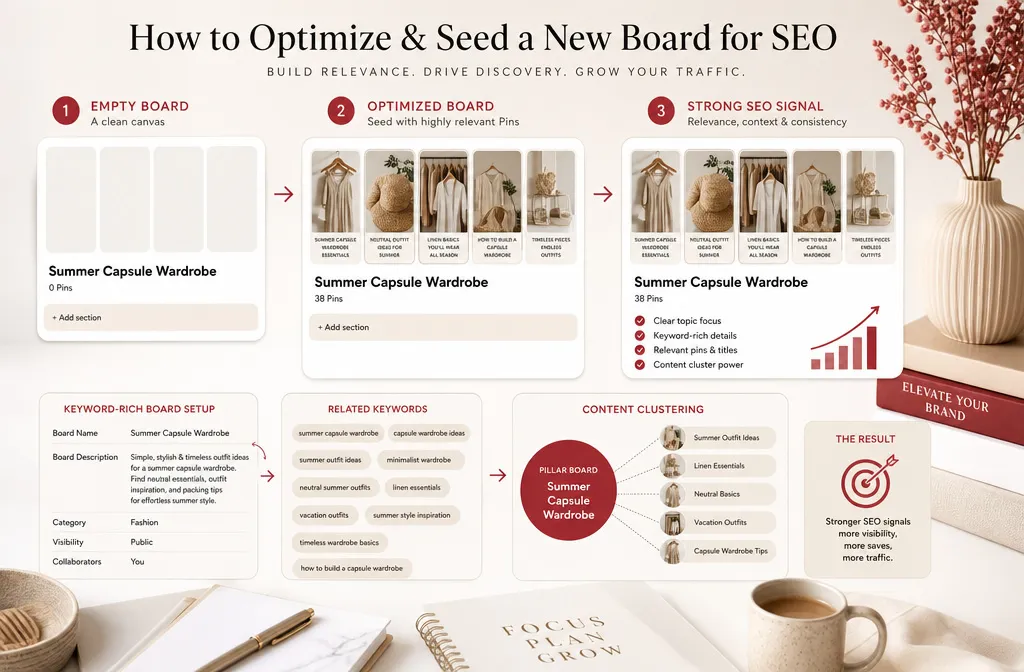
A brand-new board idea is essentially invisible to Pinterest until something is actually pinned to it. Rather than jumping straight to your own pins, spend a few minutes saving a handful of already-popular pins on the same topic first, a tactic generally known as board seeding.
The logic is straightforward: Pinterest can’t infer what an empty board is about, so giving it a batch of clearly on-topic pins upfront gives the algorithm something to work with right away. You’ll find candidates by browsing what Pinterest itself suggests when you first create the board, or by searching your target keyword and noting which pins are already getting engagement.
Boards that skip this step tend to sit quietly for months with no obvious explanation, simply because Pinterest never got a clear signal of what they’re actually for.
Match Board Names and Descriptions to the Idea
A strong board idea can still underperform if the name and description don’t reinforce it. Keep the name itself simple and keyword-focused rather than clever. “Small Kitchen Storage Ideas” outperforms something like “Awesome Kitchen Stuff You’ll Love,” where a vague adjective takes the place of an actual keyword.
Save the synonyms and related terms for the description instead of repeating the board name. Aspirational, benefit-driven language, plus 2 to 3 natural sentences describing what followers will find, gives Pinterest additional keyword context without looking stuffed.
How Many Board Ideas Is Too Many?
There’s no hard cap, but structure matters more than count. Going wide with many narrow, relevant boards beats consolidating everything into a handful of broad ones, since narrow boards give Pinterest a clearer read on each pin’s context.
Watch for redundant board ideas that target the same audience with different wording, like “Budget Meal Prep Ideas” next to “Cheap Meal Prep Ideas.” Pinterest’s own guidance suggests keeping individual boards in a healthy range rather than letting any single board balloon into an unfocused catch-all, since a tightly curated board is easier for both Pinterest and followers to make sense of than an overstuffed one.
If mapping out pillar, long-tail, seasonal, and cluster board ideas for an entire account sounds like a lot to structure on top of everything else running a blog or shop involves, that’s the exact gap a Pinterest SEO service is built to close.
If you think you need help getting your Pinterest boards structured and want to actually grow your traffic through Pinterest, that’s what our PintereSEO service is built for — book a free discovery call, and we’ll handle the keyword research, board structure, and seeding for you.