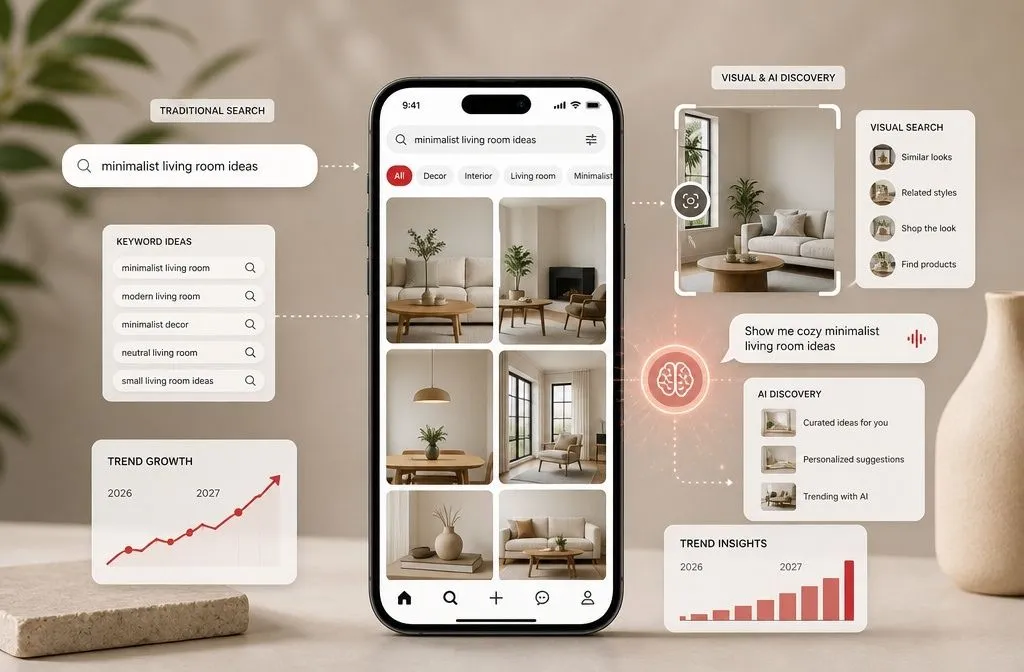
Most Pinterest SEO trend articles were written in November of the previous year, and it shows. They recycle the same five bullet points about keywords and consistency without checking whether Pinterest actually changed anything.
Pinterest shipped a lot. Between October 2025 and June 2026 the platform launched an AI shopping assistant, gave users a switch to filter AI-generated Pins out of their feeds by category, signed a $4 billion cloud deal to rebuild its visual search infrastructure, and started testing a conversational app that lives outside the main product.
Each of those changes affects how your Pins get found. Here is what the evidence says, sourced from Pinterest’s own filings and announcements rather than from other blogs.
What Pinterest’s own numbers say about 2026
Start with scale, because it sets the ceiling on everything else.
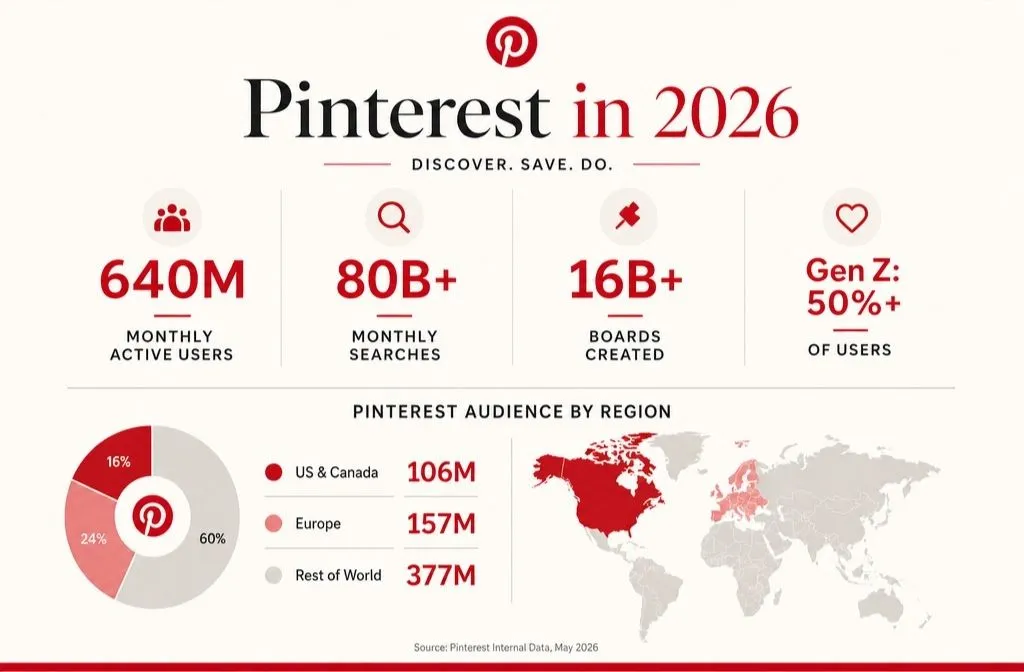
Pinterest reported 640 million global monthly active users in Q2 2026, up 11% year over year, alongside revenue of $1,180 million. That marked a record user count for the twelfth consecutive quarter. Growth is not evenly spread: the US and Canada grew 4% to 106 million, Europe grew 8% to 157 million, and the Rest of World region grew 15% to 377 million.
Two figures from the Q2 earnings deck matter more for SEO than the headline number. Pinterest describes a feedback loop built on more than 80 billion monthly searches and over 16 billion boards created. And Gen Z is now more than half the user base and the fastest-growing cohort.
Read those together, and the picture is clear. Search volume on the platform is enormous and still climbing, but the audience mix is shifting younger and increasingly international. If your traffic has flattened while Pinterest keeps reporting record users, the growth is probably happening in regions or age brackets your content does not serve.
The Pinterest SEO trends that changed the game this year
These are the shifts backed by an actual product launch, not by somebody’s prediction post.
1. AI labels turned human-made content into a ranking advantage
Pinterest began labeling AI-generated and AI-modified images in April 2025, then went further. The upgraded tuner lets users see less GenAI content on eligible image Pins in categories highly prone to AI modification, including architecture, art, beauty, entertainment, fashion, health, home decor, sport and food and drink, managed in Settings under “refine your recommendations.”
Pinterest’s stated reason is blunt. Generative AI content now makes up roughly 57% of all online material, and users told the company they want the right mix of human and AI-generated content.
For anyone pinning original photography or hand-designed graphics, that is a structural advantage you did not have to earn. For anyone running an AI image pipeline in beauty, fashion, art, or home decor, a growing slice of your target audience has opted out of seeing your work entirely. Detection is imperfect, and appeals exist, but the direction is set.
2. Visual search now reads the image, not just the caption
Pinterest committed to a planned $4 billion cloud services agreement with AWS through 2031, the largest infrastructure commitment in its history, expanding compute and custom silicon to power AI at scale and deliver a more responsive search and shopping experience.
That spend is aimed squarely at visual understanding. Practically, it means the image itself carries more ranking weight than it did two years ago. A clear, well-lit, unambiguous photo of a finished result gets classified correctly. A dark, cluttered, heavily filtered image does not, no matter how good your description is.

The old workaround of a weak image plus a keyword-stuffed description is closing.
3. Search is going conversational, and keywords alone will not carry it
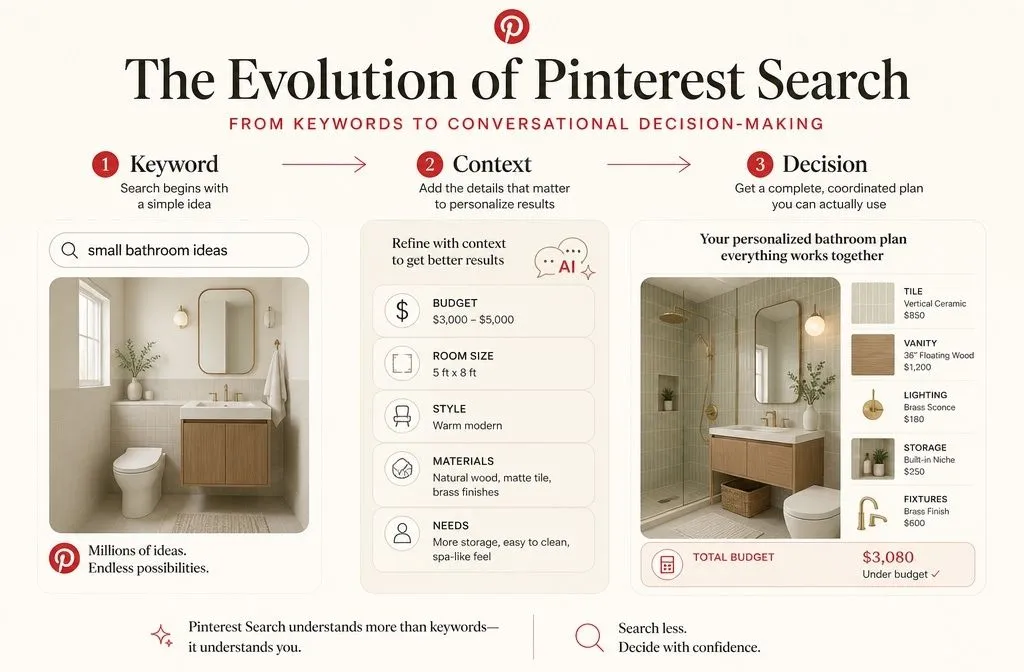
In June 2026 Pinterest introduced Ask Pinterest, an experimental app for conversational, visual-first and agentic shopping experiences, designed for complex multi-step decisions that do not fit into a single search, like planning a dinner party on a budget or furnishing a room over time. It followed the October 2025 launch of Pinterest Assistant inside the main app.
Chief Business Officer Lee Brown framed the shift directly: the future of discovery will be shaped by context, taste, and trusted recommendations rather than keywords alone.
The practical read for content: single-answer posts are getting weaker, and posts that resolve a whole multi-step decision are getting stronger. “Small bathroom tile ideas” is a keyword. “How to plan a small bathroom remodel under $3,000” is a decision, and it is the kind of query these systems are built to serve.
4. Boards became a personalization surface
Pinterest introduced AI-powered upgrades to boards to transform them from simple organizational tools into a more personalized way to browse inspiration, refine taste, and shop. The rollout included “Styled for you” AI collages built from saved fashion Pins and “Boards made for you,” personalized boards curated from a blend of editorial input and AI suggestions, tested first in the US and Canada.
Your boards are no longer just filing cabinets that give Pinterest context. They are raw material the system pulls from when assembling personalized surfaces for other users. Tight, coherent, well-named boards feed that machinery. A board called “Stuff I Like” with 400 unrelated Pins feeds nothing.
If your board structure has drifted over the years, that cleanup is now worth more than it used to be.
5. Users can filter your entire category out
The GenAI tuner is the visible version of a broader pattern: Pinterest keeps handing users more control over their feeds. Combine that with an algorithm optimizing for saved intent rather than engagement, and blanket reach becomes harder to buy with volume alone.
Precision wins. “Coastal farmhouse dining room” reaches a defined audience. “Home decor” competes with everything.
Running an account through these changes is a lot to hold in your head while also making Pins. If you would rather hand the strategy side off, book a Pinterest audit and I will map your account against these shifts and tell you what to fix first.
What has not changed, and probably will not
Every year brings a wave of posts declaring the old rules dead. The old rules are not dead.
Saves remain the strongest engagement signal on the platform, because a save is a user telling Pinterest that content is worth returning to. Keywords still drive discovery in pin titles, descriptions, board names, and board descriptions, because text is still how Pinterest maps a Pin to an interest. Fresh original images still outperform reuploads. Page relevance still matters, because Pinterest crawls what you link to and compares it against what you promised.
Patience still matters most of all. New accounts still need months before anything compounds.
The 2026 changes sit on top of these fundamentals. Nothing has replaced them.
Using Pinterest Trends to spot the next shift yourself
You do not have to wait for someone to write the next trends post. Pinterest publishes the data.
Open trends.pinterest.com, enter a keyword in your niche, and check three things: whether the search term is growing or flat year over year, when it peaks seasonally, and which Pins are currently ranking for it. Filter by the 35-and-older age group when your content monetizes through ads or affiliate links, since that bracket clicks through and converts at a higher rate than younger users browsing for inspiration. I use PinClicks for more detailed research.
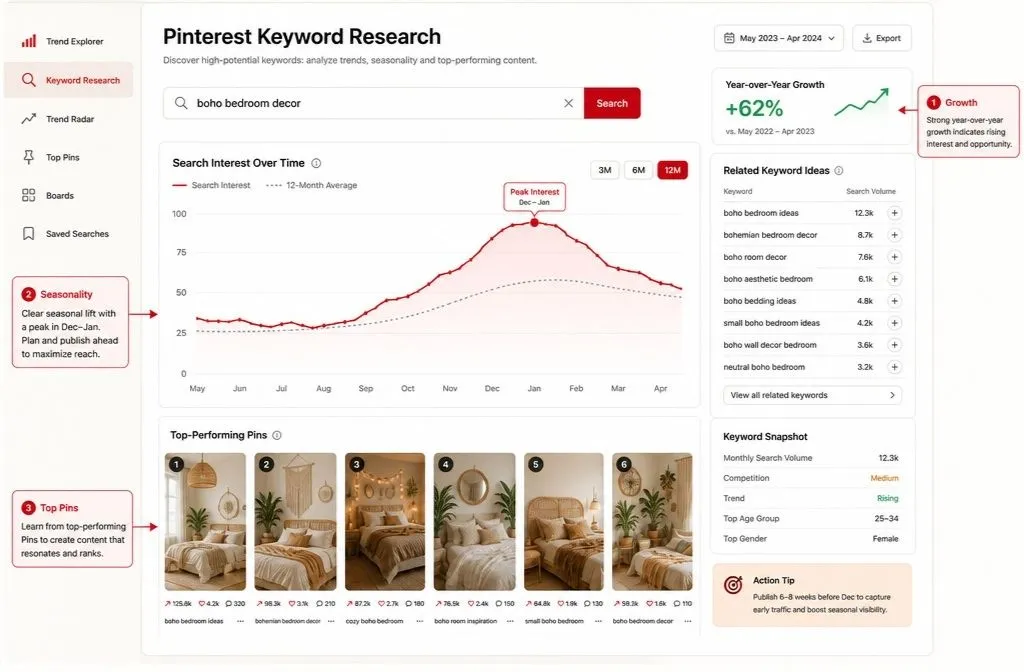
Pair the tool with Pinterest Predicts, the company’s annual not-yet-trending forecast. Pinterest positions it explicitly as a report on emerging trends for the year ahead, meant to inform design, planning, and SEO.
Then act early. Pinterest users plan weeks or months ahead of the moment, so seasonal content published 30 to 45 days out catches demand on the way up instead of on the way down.
Run this check monthly. Ten minutes in Trends beats any trends article, including this one.
Pinterest SEO predictions for late 2026 and into 2027
Flagging clearly: this section is my read on the direction, not verified fact. The sections above are sourced. These are not.
Landing page quality becomes a bigger lever than pin volume. As conversational and agentic surfaces mature, the systems answering those queries need to evaluate the destination, not just the Pin. Thin pages that exist purely to catch a click will struggle. Thorough pages that fully answer the question will pull ahead.
Original photography becomes a competitive moat in AI-filtered categories. If the GenAI tuner expands to more categories, as Pinterest has said it will, the gap between original and synthetic imagery widens further in exactly the niches where competition is fiercest.
Agentic tooling reaches organic creators. Pinterest built Pinterest MCP, an AI-native infrastructure connecting Pinterest to the copilots and agentic tools advertisers rely on, providing secure access to campaign, analytics, and keyword insights. Right now it is advertiser-facing. Extending similar access to organic accounts is a natural next step and would change how keyword research and reporting get done.
Volume strategies keep losing ground to specificity. More user-side filtering plus better content understanding means poorly-targeted Pins get filtered earlier. Fifteen precise Pins will keep beating fifty vague ones.
A 30-day plan to act on these Pinterest SEO trends
Concrete steps, in order.
Week 1: Audit. List every board. Rename anything vague to a real search phrase. Merge or archive boards holding fewer than 20 relevant Pins. Confirm your domain claim is still live and Rich Pins still validate.
Week 2: Check your images. Pull your last 30 Pins. Ask whether each one communicates its subject clearly at thumbnail size without reading the text. Anything that fails gets redesigned. If you use AI imagery in beauty, fashion, art, home decor, or food, split-test original photography against it and track saves separately.
Week 3: Rebuild your keyword list around decisions. Take your top five keywords and rewrite each as a complete decision a person is trying to make. Map one post per decision. Check each in Pinterest Trends before committing.
Week 4: Fix the destination. Open the five pages driving the most Pinterest traffic. Check load time, confirm the H1 matches what your Pins promise, and add the sections that answer the follow-up questions a reader would have. Every fix here compounds across every Pin pointing at that URL.
Repeat the Trends check monthly. Repeat the full audit quarterly.