Pinterest SEO for recipe blogs follows most of the general Pinterest playbook, then breaks from it in about four places that matter a great deal. Food is the one category where the standard advice about text overlays is wrong, where your recipe card does structural SEO work no other niche gets, and where seasonal timing decides whether a post earns for six weeks or six years.
What follows is the food-specific version: what to set up, how to find keywords people actually search when they are hungry, how to design pins that get clicked instead of just saved, and what changed on the platform in 2026.
Why Pinterest behaves differently for recipe content
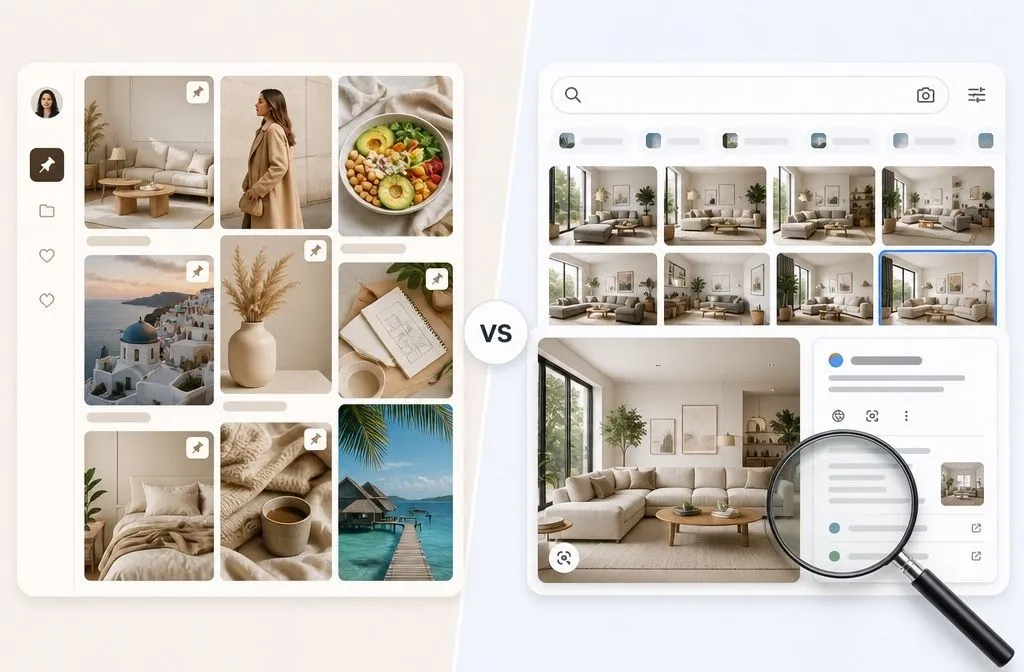
Pinterest is a search and discovery platform before it is a social one. Users arrive with a query, save results for later, and come back when they are ready to cook. The platform reported 640 million monthly active users in Q2 2026, its twelfth consecutive record quarter, and food remains one of its largest categories.
Two consequences follow for recipe bloggers.
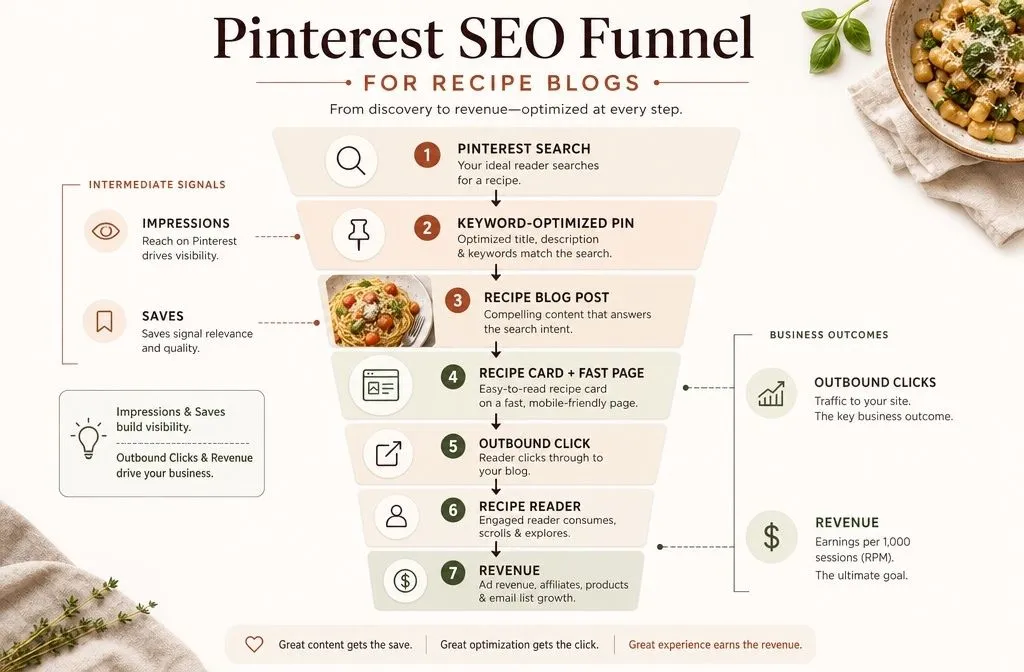
First, a pin has no expiry. A dinner idea saved in March can resurface next March, and the same post can earn for years. Second, the intent gap between saving and cooking is where recipe blogs lose money. A user who saves your pin and never clicks gives you an algorithmic signal and zero pageviews. Optimizing only for saves builds a nice-looking account with disappointing analytics. Aim for saves and outbound clicks. The design section below focuses mostly on the second.
Step 1: Foundation setup for a recipe blog
Three things need to be true before any pinning strategy matters.
Convert to a business account and claim your domain
A Pinterest business account unlocks Pinterest Analytics, which you need to read outbound clicks by pin. Claiming your site connects every pin linking to your domain back to your profile and gives you the analytics on content other people pin from your blog.
Claim via the DNS TXT record method rather than the HTML tag if you have DNS access. A theme update or plugin change cannot break a DNS record.
Enable recipe rich pins, not article rich pins
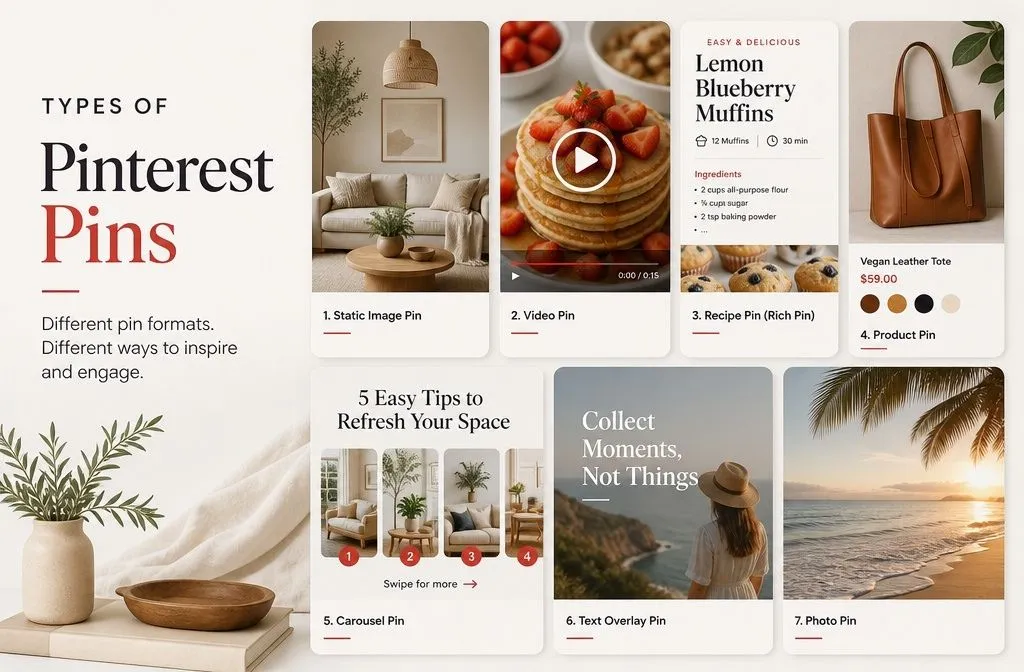
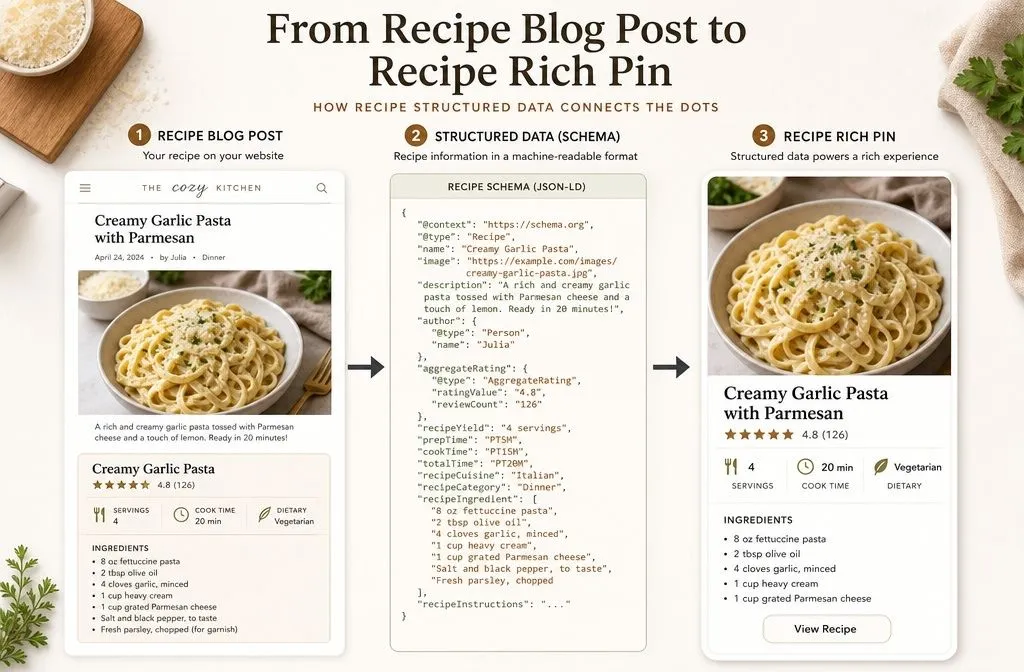
Recipe rich pins are the single biggest structural advantage food bloggers have on Pinterest. According to Pinterest’s own documentation, recipe rich pins add a title, serving size, cook time, ratings, diet preference, and an ingredient list to pins that link to your site, and they update automatically when you edit the post.
Setup requires Schema.org or h-recipe markup on the page. Any mainstream recipe card plugin (WP Recipe Maker, Tasty Recipes, Create by Mediavine, Recipe Card Blocks) outputs this for you. Ratings information can only be passed through Schema.org markup, and Pinterest notes that ratings display on iOS and Android, not desktop.
Two details people get wrong:
- Pinterest treats listicles and image-heavy pages as something other than articles, so a roundup post will not reliably return article-rich pin data. Individual recipe posts with a proper recipe card will.
- Sync is not instant. Allow up to 24 hours after the markup goes live.
If both article and recipe markup exist on a page, Pinterest picks one based on its own data priority. Recipe markup is what you want winning on a recipe post.
Step 2: Keyword research for recipe content
Pinterest search language differs from Google search language. Google gets “chicken adobo recipes.” Pinterest gets “easy filipino recipe,” “high protein lunch ideas for work,” “freezer meals for busy moms.” The platform runs on situations, not ingredients.
Work these four sources in order.
Pinterest search autocomplete. Type your core term logged out and record every suggestion. These are live queries. Then type your term plus a preposition: “chicken recipes for,” “dinner ideas with,” “meals without.” Qualifier terms turn a broad head term into a list of long-tail post ideas, and each result is a candidate for its own post and its own pin.
Pinterest Trends (trends.pinterest.com). Filter by age group. The 35 and older segments generally click through more and monetize at higher RPMs than teen and young adult segments, which is important when your revenue is display advertising.
Search bubbles. The colored tiles above search results are Pinterest telling you which modifiers it associates with your term. “Healthy,” “crockpot,” “for two,” “make ahead.” Each tile is a board idea or a post angle.
Your own analytics. Pull the top-performing pins from the last 12 months and look at which keyword pattern repeats. That pattern is what Pinterest has already decided your account is good at, and pushing into it is cheaper than starting a new topic.
Cluster the results instead of chasing single keywords. One core topic like “sheet pan dinners” supports “sheet pan chicken dinners,” “sheet pan salmon,” “sheet pan breakfast,” and a roundup that links to all of them. Users who engage with one pin in a cluster get shown the rest.
Seasonal keywords need lead time. Pinterest users plan ahead, so seasonal recipe content should be live and pinned roughly 30 to 45 days before the holiday or season peaks. Thanksgiving pins published in late November are competing for the leftovers of a search wave that started in October.
Step 3: Board structure that helps a recipe blog
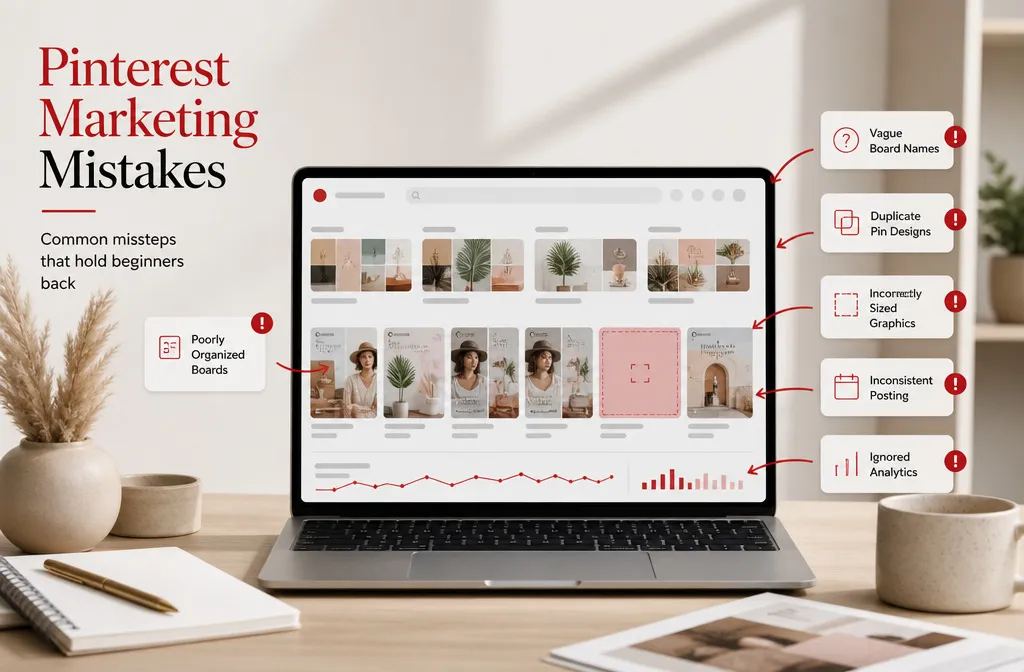
Board names should read like search queries, not like personality. “Easy Weeknight Dinners” works. “Delicious” does not.
Build wide rather than deep. Many focused boards give the algorithm clearer context and give you more distinct places for the same recipe to live. A single chicken recipe can legitimately sit in “Chicken Recipes,” “Easy Dinner Ideas,” and “30 Minute Meals,” provided each pin is a different image with a title matching that board’s intent.
Avoid synonym boards. “Quick Dinners” and “Fast Dinner Recipes” split your own signal across two places for no gain.
For board descriptions, skip repeating the board name. Use the space for synonyms, meal types, dietary angles, and the situations the recipes solve. Words like “ideas,” “inspiration,” and “easy” reflect how people actually phrase Pinterest searches.
New boards start cold. Before adding your own recipes, save 20 or more strong, recent, closely related pins from other accounts. Seeding gives the algorithm a topical fingerprint for the board so your first pins get distributed to the right feeds instead of guessing.
Step 4: Pin design, where food breaks the standard rules
Pinterest recommends a 2:3 aspect ratio, ideally 1000 x 1500 pixels, and its creative guidance notes that other ratios can hurt performance. Pins taller than roughly 1:2.1 get cropped in the feed, which usually cuts off the bottom third where people put their logo or call to action.
Now the food-specific part.
Do not cover the dish. In home decor, beauty, and informational niches, a dark overlay with white text across the whole image can lift click-through because it forces curiosity. Food is the exception. People decide to click a recipe by looking at the finished dish. Hide it, and you remove the only thing that sells the click. Stack your text in the top or bottom band and leave the food clearly visible.
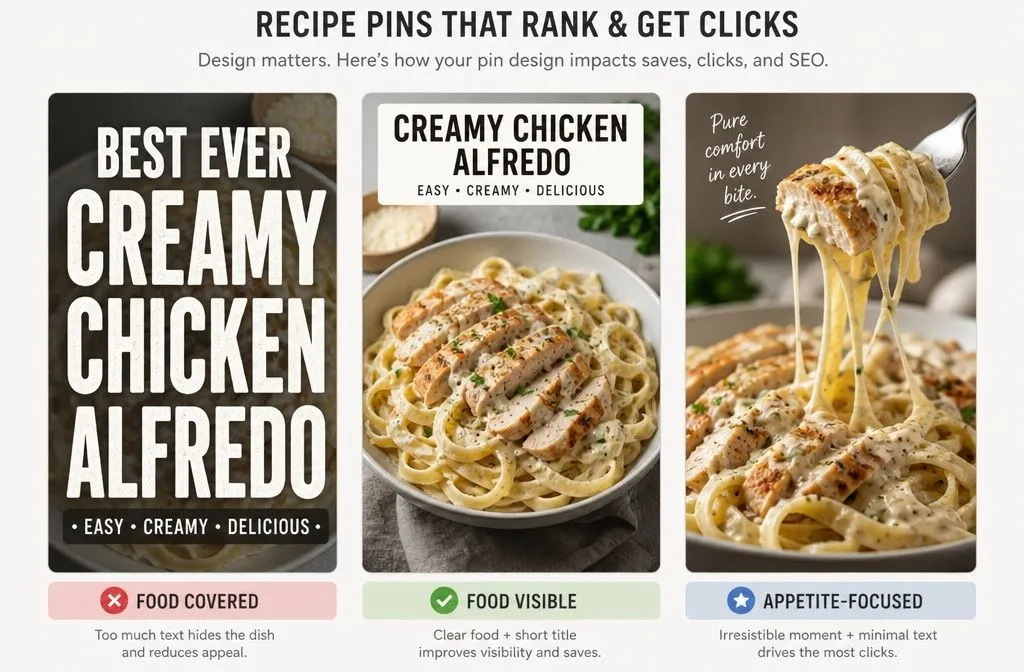
Photograph the moment of appetite. A cheese pull, a fork lifting a bite, a cut cross-section, a pour shot. Flat, evenly lit plate photos read as stock and scroll past.
Keep text short and legible at thumbnail size. Most Pinterest usage is mobile. Six words in a large sans serif beats twelve words in a script font every time.
Vary your designs. Accounts running one template across hundreds of pins tend to plateau. Rotate two or three distinct layouts and test a new concept regularly.
For a single recipe post, a workable set is one hero photo pin with a small title band, one text-forward pin using a different photo from the same shoot, one process or step collage, and one seasonal or dietary variant published later in the year. Each is a genuinely different image, not a color swap.
Step 5: Pin titles, descriptions, and alt text
Pin titles carry real ranking weight and also decide the click. Combine the searchable term with a specific promise: “Sheet Pan Chicken and Veggies (One Pan, 30 Minutes)” beats “Delicious Chicken Dinner.”
Demographic and situation modifiers work well in food: for busy weeknights, for meal prep, for picky eaters, for two. Numbers work. Cook times work, because a time is a promise the reader can evaluate instantly.
Descriptions should read like a person wrote them. Three to five sentences covering what the dish is, why it is worth making, the main keyword, two to five natural synonyms, and a light call to action. Skip the keyword lists separated by commas. Pinterest reads context, and stuffed descriptions do not outperform natural ones.
On hashtags, the honest answer is that they are no longer a discovery mechanism on Pinterest and their current value is contested among practitioners. Keywords in your title, description, board name, and the text on the image itself do the work. If you keep hashtags, keep them to a few specific ones and treat them as a rounding error rather than a strategy.
Alt text should describe the image plainly for accessibility. Write it for a screen reader user, and let the keyword appear only where it fits naturally.
Step 6: The on-page work that decides whether traffic converts
Pinterest crawls the page behind every pin, and Google reads the same page. Fortunately, the two overlap almost entirely for recipe content.
Your recipe card handles the structured data. Google’s recipe documentation requires the recipe name and image at minimum, with cook time, yield, nutrition, and ratings as recommended additions that make the result richer. Validate with the Rich Results Test after any theme or plugin change.
Beyond schema:
- The H1 and page title should contain the term your pins are targeting. If several pins with different angles point at one post, use those angles as H2s and H3s so the page supports each of them.
- A jump-to-recipe button belongs near the top. Pinterest traffic is high intent and low patience.
- Watch ad density above the recipe card. Pinterest tolerates ad-heavy pages better than Google does, but a reader who bounces before the ads render earns nothing.
- Page speed under three seconds, compressed images, no broken links. A viral pin sending a spike to a slow page wastes the spike.
If the pin promises a 20-minute dinner and the post opens with 900 words of backstory before the cook time appears, the click was wasted. Match the promise inside the first screen.
Step 7: Cadence, and what actually changed in 2026
Consistency beats volume. Pinterest’s stated position is that fresh, high-quality content gets better distribution, where fresh means an image and link combination the platform has not seen before. Reposting the same image to five boards is the pattern most likely to quietly kill your reach.
A sustainable rhythm for most recipe blogs is 5 to 15 new pins a day, spread across topics and boards, built from a batch created in one sitting. Ramp there gradually on a new account rather than starting at 40.
Worth saying plainly: 2026 has been harder for established food bloggers on Pinterest. Practitioners who manage food accounts at scale, including Simple Pin Media’s Kate Ahl, have reported year-over-year traffic declines for established creators alongside a flood of AI-generated content, while newer accounts still find traction. Pinterest traffic to food blogs also tends to carry strong RPMs, so the traffic that does arrive is worth more per visitor than most sources.
The practical read is that volume alone stopped working. Original photography, a real face and voice on the profile, recipes that show actual testing, and pins that clearly come from a human are the differentiators now. If your account has flatlined, diagnose it before you pin more: low impressions points at keywords, boards, or a design problem, while high impressions with low clicks points at the pin itself.
Step 8: Track the two numbers that matter
Impressions and saves feel good. Outbound clicks pay.
Check monthly in Pinterest Analytics: outbound clicks by pin, saves by pin, and which boards drive the clicks. Cross-reference against GA4 for session duration and RPM by landing page from Pinterest referral traffic. The recipes with the best click-to-revenue ratio are the ones to spin variants of, add fresh pins to, and cluster around.
Then repeat the winners deliberately. Compounding on Pinterest comes from finding one topic your audience responds to and covering it exhaustively, not from covering everything once.