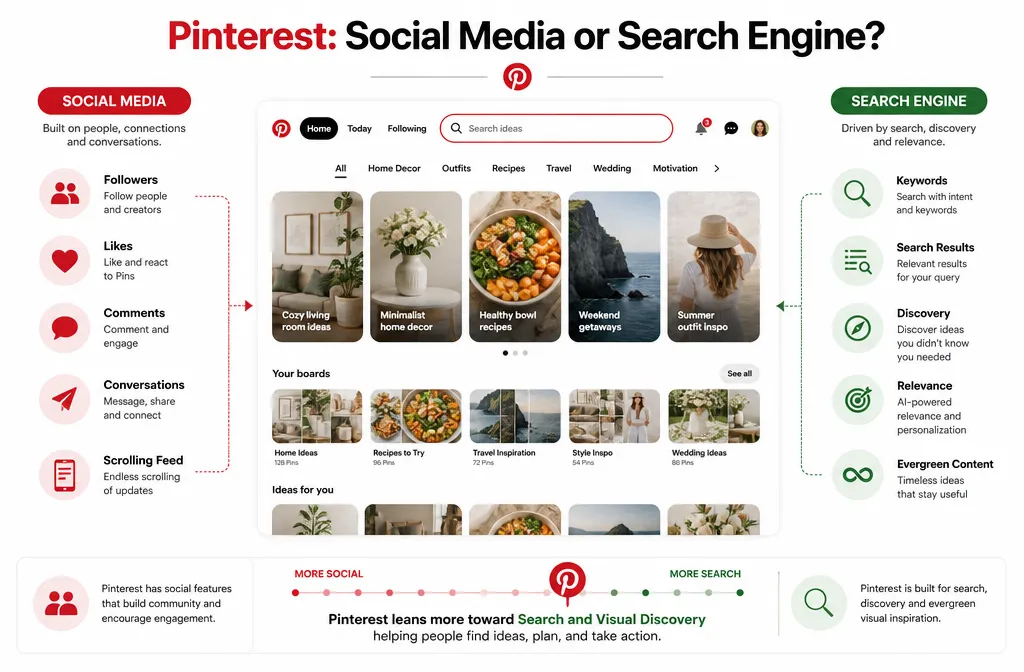
Pinterest has a profile page, a follow button, and a comment section. On paper, that puts it in the same bucket as Facebook or Instagram. But if you’ve ever wondered what Pinterest is and how it works, the mechanics tell a different story than the interface does. Pinterest itself doesn’t call itself social media. It calls itself a visual discovery engine, and the way people use the platform backs that up.
This matters for more than trivia. Whether you treat Pinterest like social media or like a search engine decides how you plan content, and only one of those approaches produces traffic that compounds over time.
What Counts as Social Media?
Before judging Pinterest, it helps to define the category. Traditional social platforms share a few core traits: user profiles, connection systems like following or friending, activity feeds built around engagement, and real-time interaction through likes, comments, and direct messages. The product exists to facilitate conversation between people.
Facebook, Instagram, and TikTok all fit this mold. Content works as a conversation starter. The relationship between users, not the content itself, is the actual product.
How Pinterest Works
Pinterest borrows the vocabulary of social media (profiles, boards, following), but the underlying system runs closer to a search engine.
The Search Bar Is the Core of the Product
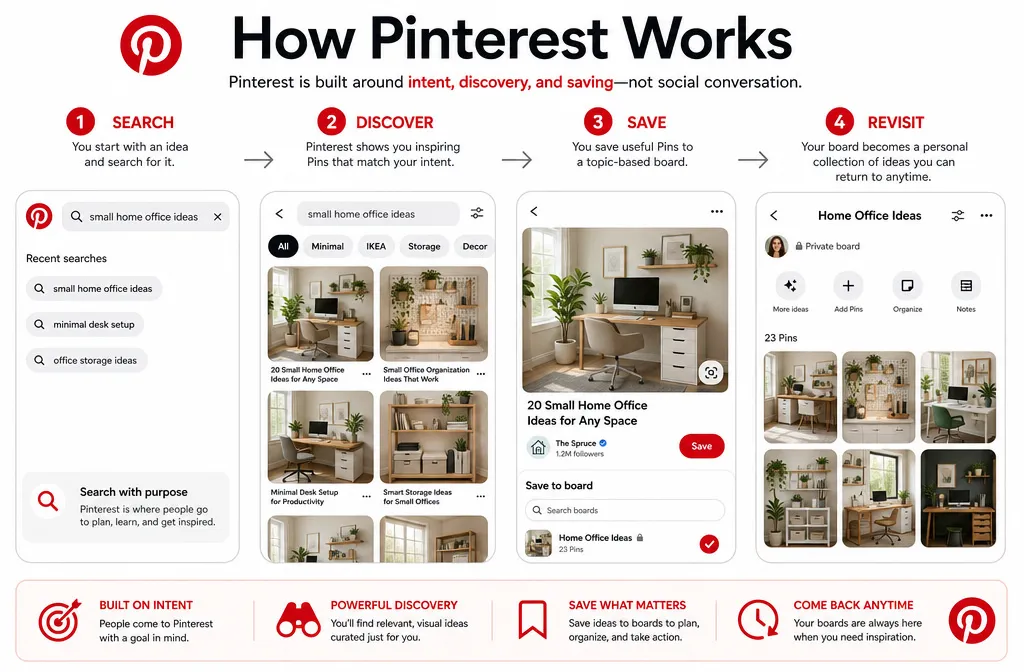
Open Pinterest and the first thing most people do is type a query into the search bar, not scroll a feed of people they follow. According to Pinterest’s own Help Center, the platform is a visual discovery engine for finding ideas like recipes, home and style inspiration, and more. Search results come back as a grid of Pins ranked by relevance to the query, the same basic pattern as a Google search, not a chronological or follower-based feed.
Boards work like folders for that search behavior. Users save Pins into topic-based collections they can revisit later, which is closer to bookmarking than posting.
What Pinterest Itself Calls It
This isn’t just how outside marketers describe Pinterest. Pinterest’s own leadership has said the same thing directly. In a 2015 interview, co-founder Ben Silbermann told Fortune that Pinterest works differently from a social network because the goals are different: on a social network you post for other people, while on Pinterest, you’re browsing for yourself. He described the platform as a hand-picked catalog rather than a feed built for other people’s approval.
That framing has held up. A decade later, Pinterest’s product and marketing materials still lead with “visual discovery engine” rather than “social network.”
Where the Social Features Fit In
None of this means Pinterest has zero social features. Users can follow accounts and boards, comment on Pins, collaborate on shared boards, and message other users directly. Researchers and app-store categories generally file Pinterest under social media because it meets enough of the technical criteria.
The difference is emphasis. On Instagram, the social layer is the point. On Pinterest, it’s a secondary feature bolted onto a search-and-save system. Most people open Pinterest to plan something for themselves, not to see what a friend posted.
Pinterest vs. Social Media vs. Search Engine
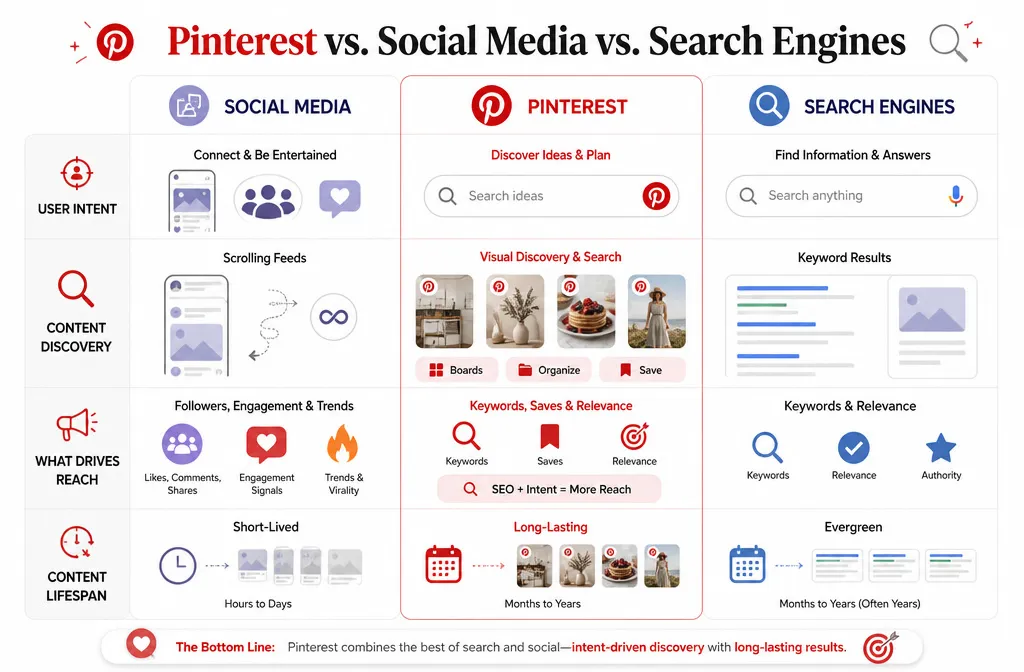
Lining up the three models side by side makes the pattern clear.
| Factor | Social Media (Instagram, TikTok) | Search Engine (Google) | |
| Why people open it | Entertainment, catching up with people | Planning, ideas, shopping | Answers, solutions |
| How content surfaces | Pushed through a feed | Pulled through search and interests | Pulled through search |
| What decides reach | Followers, engagement velocity | Keyword relevance, pin quality | Keyword relevance, authority |
| Content lifespan | Hours to a few days | Months, often longer | Months to years |
| Do you need followers? | Yes, largely | No | Not applicable |
A zero-follower Pinterest account can outrank a large one for the same search term if the pin and its linked page match the query well. That single fact explains most of the strategic gap between Pinterest and true social platforms.
The Data Behind the Debate
The numbers back up the search-engine framing more than the social one. As of Pinterest’s Q2 2026 results, the platform reported 640 million global monthly active users, an 11% increase year over year. That scale alone puts Pinterest in the same conversation as major social platforms.
But look at how people use that scale. Pinterest’s own audience data shows the platform is 70% women and 30% men globally, with Gen Z as its fastest-growing segment, making up 42% of the global user base. More tellingly, 96% of top searches on Pinterest are unbranded, meaning almost nobody is searching for a specific company or account. They’re searching for ideas the way they’d search Google, not looking for people they already know.
Why the Label Changes How You Should Use Pinterest
If Pinterest behaved like Instagram, the winning strategy would be posting consistency, trend-jacking, and engagement bait. Since it behaves like a search engine, the winning strategy looks more like SEO: research what people type into the search bar, build pin titles and board names around those terms, and publish consistently so the library of ranked content keeps growing.
This is also why Pinterest rewards patience differently than other platforms. A pin published today can keep resurfacing in search results for months, because it’s tied to a keyword that people keep searching, not to a feed algorithm that forgets it after 48 hours. Treating a pin like a single social media post wastes that advantage.
For a blog or business, this distinction is the difference between chasing likes and building a second search engine’s worth of findable content. Setting up a Business account is the first practical step toward that, since it unlocks the analytics needed to see which keywords are working.